Treasury Overview
Overview
Every token on UNIT has a treasury: a pool of other assets held behind it. The treasury is what gives a token something to be worth, and it is public — you can open any token's treasury and see exactly what stands behind it.
Three tabs run across the top: OVERVIEW, REDEEM and HISTORY.
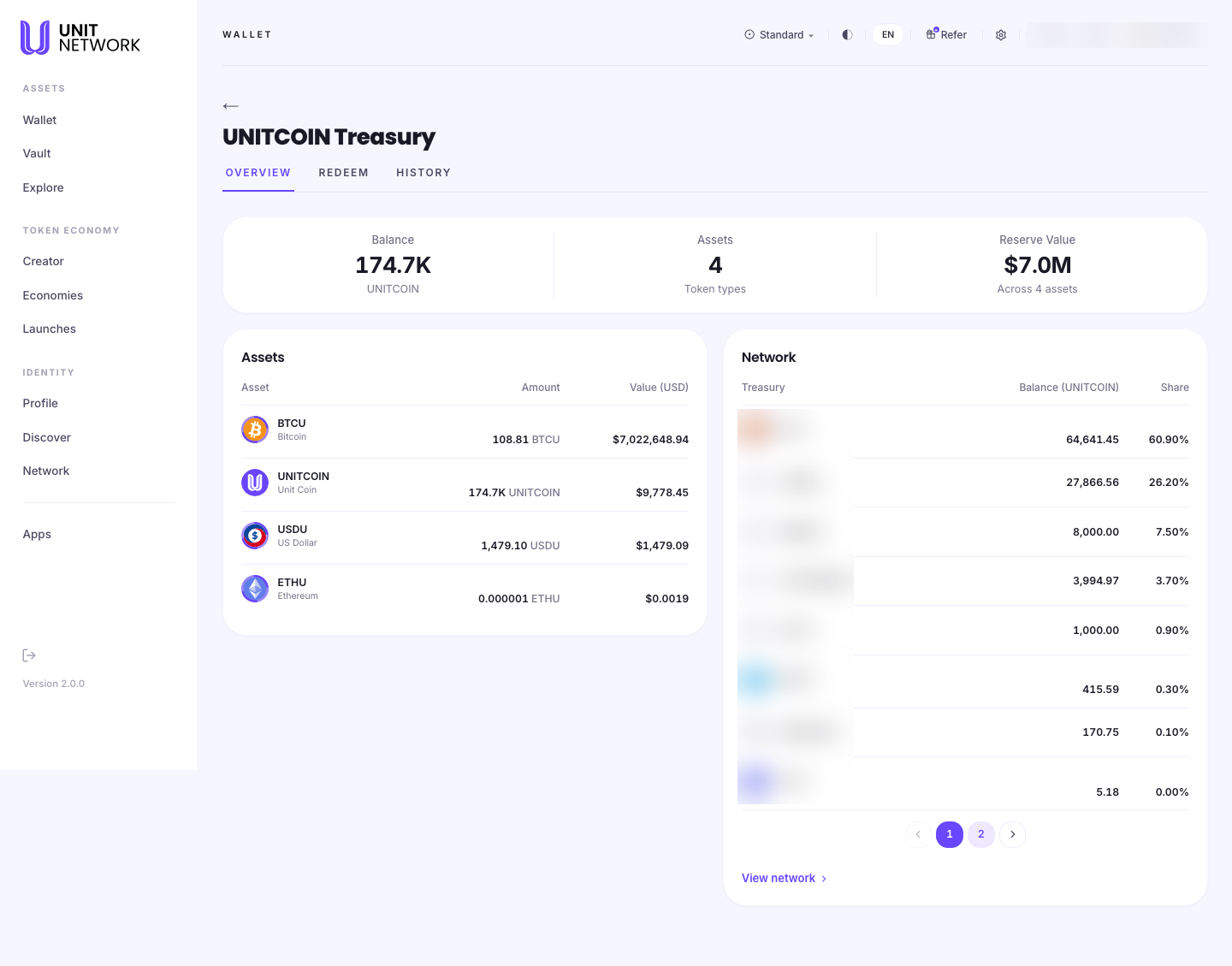
What You Can See
The three figures
- Balance
- How much of its own token the treasury holds.
- Assets
- How many different token types are in the reserve.
- Reserve Value
- What the whole reserve is worth in dollars. This is the headline number — what actually stands behind the token.
The overview shows two tables that look similar and mean opposite things. Assets is what this treasury holds. Network is which other treasuries hold this token.
They cross-check each other. UNITCOIN's Assets table lists 1,479.10 USDU; open USDU's treasury and its Network table shows UNITCOIN holding 1,479.10 USDU at 99.20%. Same holding, seen from each end.
Assets — what this treasury holds
Three columns: Asset, Amount and Value (USD). Read it as an inventory of the reserve. A treasury weighted almost entirely into one asset — as UNITCOIN's is into BTCU — tells you what the token is really backed by.
A treasury with nothing in it says so: "This treasury holds no assets."
Network — who holds this token
Three columns: Treasury, Balance and Share. This is the reverse view — other tokens' treasuries that have taken a position in this one, and how much of the total each represents.
It is a useful measure of standing. A token held in many treasuries is one other economies have chosen to back themselves with. The list pages if it is long, and View network opens the fuller picture.
Before You Begin
- Nothing to look. Every treasury is public and readable without signing in.
- A token in mind. Treasuries are per token — reach one from that token's page in Explore, or use the Treasury tile on Apps for UNITCOIN's.
How to Use This Screen
Judge what stands behind a token
- Open the token from Explore and select Treasury.
- Read Reserve Value first — it is the total behind the token.
- Look at the Assets table to see what that value is made of. One asset at 99% is a very different proposition from four balanced ones.
- Check whether the reserve is in assets you understand — wrapped majors like BTCU and ETHU, a stablecoin like USDU, or other creator tokens.
See how widely a token is held
- Scroll to the Network table.
- Read the Share column — one treasury at 90% means concentrated support, many small holders mean broad support.
- Select View network for the fuller list.
- Open any treasury in that list to look at it the same way.
What Happens Next
Nothing — the overview is a reading screen. Acting on what you see means Redeem, and the record of everything that has moved through the treasury is on History.
Tips
- Reserve Value is the number that matters. A token's price is one thing; what is actually held behind it is another.
- Read the two tables in opposite directions. Assets is what it holds; Network is who holds it.
- Concentration cuts both ways. A treasury entirely in one asset rises and falls with that asset.
- An empty treasury is not hidden — the screen says so plainly.
- Follow the Network table to discover economies you had not looked at. A treasury that has taken a position in a token has made a judgement about it.
Related Screens
- Redeem — exchange tokens for a share of the reserve
- Treasury History — everything that has moved through it
- The Token Page — where treasuries are reached from
- Tokenomics & Reserves — the owner's view of a treasury
Frequently Asked Questions
- Does every token have a treasury?
- Yes, though it may be empty. A treasury with nothing in it reads "This treasury holds no assets."
- Why does the treasury hold its own token?
- The Balance figure is the treasury's holding of its own token, kept separately from the reserve of other assets.
- What is the difference between the Assets and Network tables?
- Assets is what this treasury holds. Network is which other treasuries hold this token. Opposite directions.
- Can I see any token's treasury?
- Yes. They are public.
- Is Reserve Value the same as market capitalisation?
- No. Reserve Value is what the treasury actually holds. What the token trades at is a separate matter, shown on the token page.
Troubleshooting
- The Assets table is empty
- That treasury holds no reserve. The screen says so; nothing is broken.
- The Network table is long
- It pages. Use the page numbers, or View network for the fuller list.
- The figures do not match the token page
- They measure different things — reserves held, versus what the token trades at.