The Reward Pool
Overview
Rewards have to come from somewhere. The reward pool is that somewhere — "reward inventory distributed to stakers", set aside by the token owner out of the token's own supply.
This is the owner's side of Claim Rewards. If you hold a token, it is worth understanding because it tells you whether the rewards you are being offered are actually funded.
Where to find it
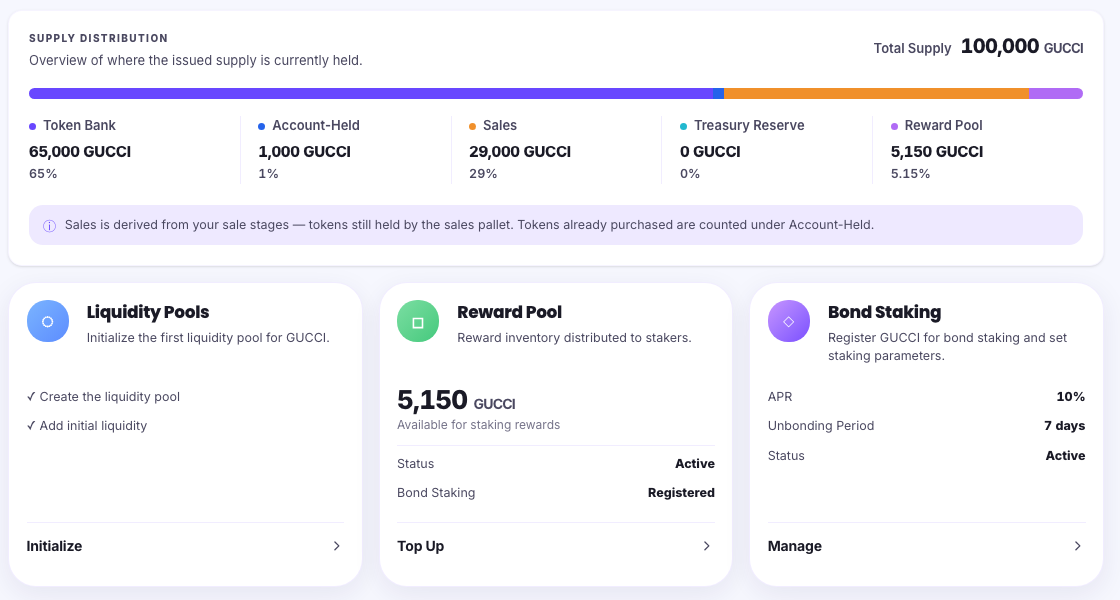
In Economies, open your economy and select Tokenomics & Reserves. The reward pool sits in the supply distribution and has a card of its own.
What You Can See
The reward pool as a share of supply
The supply distribution bar shows where every issued token currently sits — token bank, account-held, sales, treasury reserve, and the reward pool. Seeing the reward pool as a percentage is the useful part: it is inventory committed to paying stakers rather than held, sold or reserved.
The reward pool card
- Available for staking rewards
- What is in the pool. This is the fuel — when it runs out, there is nothing to pay from.
- Status
- Active when the pool is operating.
- Bond Staking
- Registered when the token has been set up for staking. Without that, a pool has nothing to pay into.
- Top Up
- Opens the Fund Reward Pool workspace, where the amount is composed and every past funding is listed.
Bond staking, beside it
The neighbouring card sets the terms the pool pays on — "Register GUCCI for bond staking and set staking parameters":
- APR
- The annual rate stakers earn. The same figure they see on their reward statement.
- Unbonding Period
- How long a staker waits to get their principal back after unstaking.
- Status
- Whether staking is live.
The two cards work together: bond staking sets the promise, and the reward pool pays for it.
Before You Begin
- Your own economy. These controls belong to the token owner — see Economies.
- Tokens available to commit. The pool is funded out of supply, so tokens in it are no longer available for anything else.
- A rate you can sustain. The APR you set determines how fast the pool drains.
How to Use This Screen
Check whether rewards are funded — as a holder
- Open the token's economy from Economies.
- Select Tokenomics & Reserves.
- Find Reward Pool in the supply distribution and read its share.
- Read the card: is Status active, and is Bond Staking registered?
- Compare the pool against the APR on the bond staking card. A high rate paid from a small pool will not last.
Top up the pool — as the owner
- Open your economy and select Tokenomics & Reserves.
- Check what is currently available for staking rewards.
- Select Top Up to open the Fund Reward Pool workspace.
- Compose the amount, approve it and sign — the steps are on that page.
- Confirm the supply distribution now shows the larger share.
Set the terms stakers earn on
- Select Manage on the Bond Staking card.
- Set the APR. Remember it is paid out of the pool.
- Set the unbonding period — how long stakers wait for their principal after unstaking.
- Review and sign.
- Check the pool holds enough to honour the rate you have just promised.
What Happens Next
Tokens moved into the pool leave general supply and become reward inventory. The supply distribution updates to show the new share.
From then on, stakers accrue against it daily and collect on their reward statements. The pool falls as rewards are claimed, which is why Top Up exists.
Tips
- For holders: check the pool before trusting the APR. A rate is only as good as the inventory behind it.
- For owners: set the rate against the pool, not against ambition. APR and pool size together decide how long rewards last.
- Reward-pool tokens are committed. They are not available to sell, reserve or add to liquidity.
- Bond staking must be registered before a pool has any purpose.
- Watch the supply distribution as a whole — it shows what you have committed against what you still hold.
Related Screens
- Fund the Reward Pool — the workspace behind Top Up
- Claim Rewards — the holder's side of the same system
- Tokenomics & Reserves — the tab this sits on
- Earn — staking, which the pool pays
- Treasury Overview — a different reserve, for a different purpose
Frequently Asked Questions
- What is the difference between a reward pool and a treasury?
- A treasury holds other assets as backing for the token. A reward pool holds the token's own supply to pay stakers. Different contents, different job.
- Can a reward pool run out?
- It is finite inventory and falls as rewards are claimed, which is why owners top it up.
- Who can top up the pool?
- The token owner, from the economy's tokenomics tab.
- Can I see the pool for a token I do not own?
- The economy's tokenomics is where this lives. As a holder it is worth checking before staking against a promised rate.
- Does topping up create new tokens?
- No. It moves existing supply into the pool, which the distribution bar then shows as a separate share.
- What is the unbonding period for?
- It is how long a staker waits to recover their principal after unstaking. It is set with the APR on the bond staking card.
Troubleshooting
- Top Up is not available
- These controls belong to the token owner. Check you are in your own economy.
- Bond Staking shows as not registered
- Register the token for staking first, on the neighbouring card. A pool with no staking has nothing to pay into.
- The pool is falling faster than expected
- Compare the APR with the amount staked. The rate applies to everything staked, so more stakers means faster drain.
- My share in the distribution bar looks wrong
- The bar shows all five destinations against total supply. Read the note about sales — tokens already purchased count under account-held rather than sales.